 Nigel Adams
Picture a running shop selling trail shoes. Someone searches “best trail running shoes for wet weather” on Google. Someone else scrolls past a shoe advert on Instagram without a second thought. Both are ecommerce advertising, but they do very different jobs.
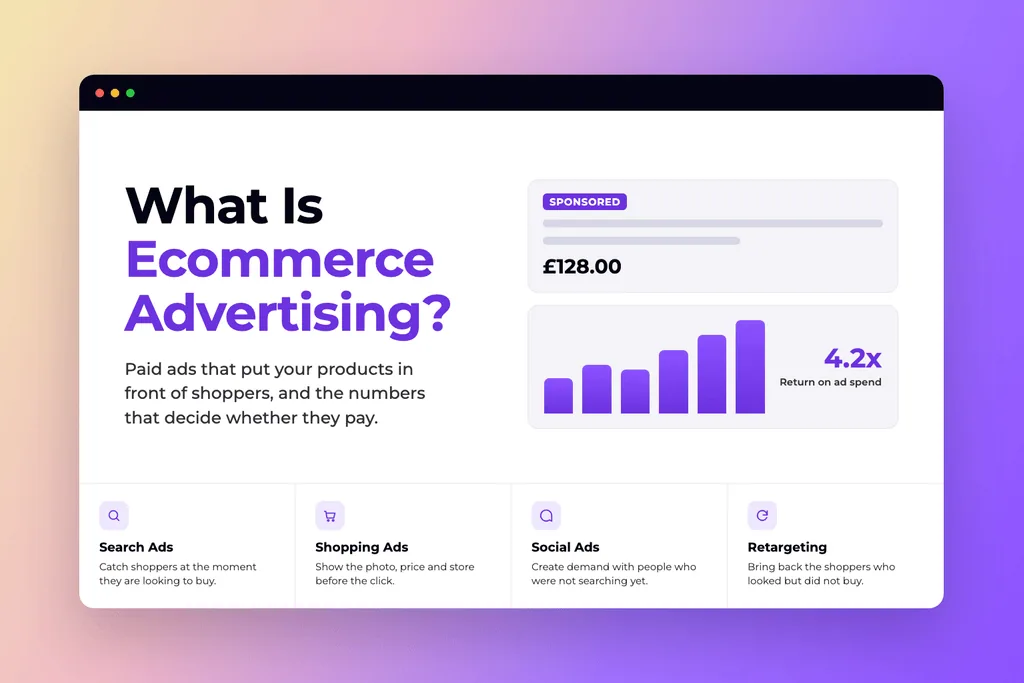
Ecommerce advertising is the paid promotion of products online, using ads on search engines, social media and other platforms to attract shoppers and drive sales. It sits alongside ecommerce SEO, email and content marketing as part of the wider ecommerce marketing toolkit, but it works faster and costs money per click or impression rather than time and effort.
For ecommerce businesses with a limited budget, the real skill is not picking a platform. It is matching the right ad type to where a shopper actually is in their buying journey, then making sure the pounds spent turn into profit rather than just traffic.
Key Takeaways
- Ecommerce advertising uses paid ads to reach shoppers, while organic marketing earns traffic through SEO and content over time.
- The right channel depends on purchase intent. Search ads catch people ready to buy, social ads introduce products to new audiences.
- A strong return on ad spend does not guarantee profit once product margins and true costs are factored in.
What Counts as Ecommerce Advertising?
Ecommerce advertising covers any paid placement that promotes products with the goal of driving a sale. That includes search ads, social media ads, display banners, video ads and shopping listings. If you are paying for the spot, it is advertising. If you earned it through good content or search rankings, it is organic marketing.
The distinction matters because the two work on different timelines and budgets. Paid advertising gets you visibility today. Organic traffic from SEO and content marketing builds slowly but keeps working without ongoing spend.
How Does Paid Advertising Differ from Organic Ecommerce Marketing?
Paid advertising means buying placement, whether that is a Google search ad, a Facebook ad or a display banner on another website. You stop paying, the traffic stops.
Organic ecommerce marketing includes SEO, content marketing and email marketing to your existing list. These build assets. A blog post or a well-ranked product page keeps attracting visitors for months or years after you publish it, which is the whole argument for investing in ecommerce SEO alongside your ad budget.
Most successful ecommerce businesses use both. Paid ads plug the gap while organic efforts take hold.
Where Do Ads Fit in the Shopping Journey?
Ads work best when matched to what the shopper is doing at that moment. Someone searching for a specific product has high intent and is close to buying. Someone scrolling social media has low intent and is not looking to buy anything yet.
This is why a single ad rarely does every job. Search ads capture existing demand. Social ads create new demand by introducing your trail shoes to someone who has never heard of your brand. Retargeting ads bring back people who looked but did not buy.
What Are the Benefits for Online Stores?
Ecommerce advertising helps online stores reach a specific target audience, build brand awareness and turn casual browsers into paying customers faster than organic methods alone. For a new store with no search rankings and a small email list, paid ads are often the only way to get meaningful traffic in the first few months.
Audience targeting lets you show ads only to people likely to buy, based on interests, past behaviour or search terms. This makes every pound work harder than a generic billboard ever could.
Reaching Shoppers and Building Brand Awareness
Targeted advertising puts your products in front of people who fit your customer profile. A running shop can show ads to people who follow marathon training pages or search for race dates.
Brand awareness matters even when someone does not click straight away. Seeing your logo three or four times before a purchase is normal, and ads plant that seed early.
Turning Relevant Traffic into Measurable Sales
Customer acquisition through ads is trackable in a way that word of mouth never was. You can see exactly which ad, keyword or audience led to a sale.
This visibility helps you spot what is driving ecommerce sales and what is wasting budget. Conversion rates, the percentage of visitors who buy, tell you fast whether an ad and landing page combination is working or needs fixing.
Which Advertising Channels Should You Use?
Channel choice should follow purchase intent, not personal preference for a platform. Google Ads and Google Shopping ads catch people actively searching for a product. Facebook, Instagram and TikTok ads introduce your brand to people who were not looking yet. Display ads, video ads, influencer marketing and affiliate marketing extend reach further down the funnel or into new audiences entirely.
Google Search and Shopping Ads for Purchase Intent
Search ads appear when someone types a query into Google, like “waterproof trail running shoes”. These shoppers already know what they want, which usually means higher conversion rates.
Google Shopping ads, also called product ads, show a photo, price and store name directly in search results. For ecommerce, this format often outperforms text ads because shoppers can compare products visually before clicking.
Shopping is also where the detail starts to matter. Your product feed is the targeting, so titles and attributes decide which searches you show for, and Performance Max will spend the budget with or without a structure behind it. I go into how I run all of that on the ecommerce PPC page.
Google is not the only search option. Microsoft Ads puts the same kind of search and shopping formats in front of people on Bing, usually at a lower cost per click, which is worth testing once your Google account is earning its keep.
Facebook, Instagram and TikTok Ads for Discovery
Social media advertising works differently. Meta Ads, the umbrella term for Facebook and Instagram, and TikTok ads reach people scrolling for entertainment rather than searching to buy.
Meta excels at showing products to people who match your existing customers’ profile. TikTok suits brands with strong visual or video content and a younger audience.
Display, Video and Partner Promotions for Wider Reach
Display ads and video ads build awareness across websites and apps your audience already visits. They are cheaper per impression but weaker on immediate conversions.
Influencer marketing and affiliate marketing bring in trusted voices to promote your products. A running influencer testing your trail shoes can carry more weight than a banner ad, particularly for considered purchases.
| Channel | Best for | Typical intent level |
|---|---|---|
| Google Search Ads | Capturing active buyers | High |
| Google Shopping Ads | Visual product comparison | High |
| Microsoft Ads | Cheaper clicks on the same intent | High |
| Facebook / Instagram Ads | Discovery and retargeting | Low to medium |
| TikTok Ads | Younger, visual-first audiences | Low |
| Display Ads | Broad brand awareness | Low |
| Influencer / Affiliate | Trust-building, niche reach | Medium |
How Do You Build Campaigns That Convert?
Converting campaigns are built in layers. Find new customers, match what they search for, bring back the ones who left, then fix anything slowing them down after the click. Skipping any one of these steps usually shows up as wasted spend.
Segment Audiences and Prospect for New Customers
Audience segmentation means splitting your audience into groups based on behaviour or interests, rather than treating everyone the same. A running shop might segment by marathon runners versus casual joggers, since they buy different products.
Prospecting campaigns introduce your brand to people who have not interacted with you before. Lookalike audiences help here. They use data from your existing customers, such as Shopify audiences, to find new people who share similar traits.
Match Search Terms, Ad Copy and Product Pages
High-intent keywords, like “trail running shoes size 9”, attract shoppers closer to buying than broad terms like “running shoes”. Negative keywords stop your ads showing for irrelevant searches, saving budget. If you are starting from scratch, my guide to keyword research for Google Ads walks through how to find the terms worth bidding on.
Ad copy should match what the shopper searched for. If someone searches for waterproof shoes, your ad and landing page should mention waterproofing rather than listing every feature you sell.
This is also where paid and organic help each other. The product and category pages you build for ecommerce SEO often make the best ad landing pages, because they are already written around what shoppers search for.
Retarget Interested Shoppers Without Wasting Spend
Retargeting ads, also called remarketing, show ads to people who visited your site but did not buy. Pixel-based retargeting tracks this using a small code snippet on your website.
Dynamic product ads take this further, showing the exact shoes someone viewed rather than a generic ad. This tends to convert better because it reminds shoppers of something they already considered.
Improve the Experience After the Click
A great ad wastes its budget if the landing page is slow or confusing. Conversion rate optimisation means testing changes, like button colour or page layout, to see what gets more people to buy.
A/B testing compares two versions of a page to find the winner. Website speed matters too, and tools like PageSpeed Insights show if slow loading is costing you sales.
How Do You Measure and Improve Ad Performance?
Measuring ecommerce ad performance means tracking what it costs to win a customer against what that customer is worth, not just how many clicks an ad gets. A campaign can look successful on the surface and still lose money once real costs are counted.
Set a Budget Using Acquisition Cost and Return on Ad Spend
Customer acquisition cost tells you how much you spend, on average, to get one paying customer. Compare this against your average order value. If it costs £30 to acquire a customer who spends £25, the maths does not work unless they buy again.
Return on ad spend (ROAS) measures revenue generated per pound spent on ads. A high ROAS does not automatically mean a profitable campaign. If your product margins are thin, even a 4:1 ROAS might barely cover costs once shipping, returns and overheads are factored in. Losing sight of that is the most expensive mistake in paid search.
Test Creatives and Bids Before Scaling
Cost per click (CPC) shows what you pay each time someone clicks an ad. Testing different images, headlines and offers on a small budget first helps you spot winners before committing serious money.
Facebook Ads Manager and Google Ads both let you run small tests across audiences and creatives. Scale only what is already proving itself, not what looks promising on day one.
Use Automation Without Losing Sight of Profit
Smart bidding and automated bidding use machine learning to adjust bids in real time, aiming for goals like more conversions or a target ROAS. These tools can save time, but they are not a guaranteed shortcut to better profit.
Automated bidding still needs clear inputs, accurate conversion tracking and a defined profit goal. Treat it as a tool to test and monitor, not a system to switch on and forget.
Choose Ads That Match Your Customers and Margins
Ecommerce advertising works best when the channel matches the moment. Search ads for people ready to buy, social ads for people not yet looking, and retargeting for those who nearly did. Organic marketing builds long-term value, but paid ads fill the gap while that groundwork takes hold.
The real test of a campaign is not clicks or even ROAS. It is whether the numbers still work once acquisition costs, margins and repeat purchases are counted. Test small, watch the data closely, and scale only what proves itself with your own customers and products.
If you would rather have someone else build and watch the numbers, I work with online stores on both sides of this, from paid search and social campaigns through to the ecommerce SEO that lowers what you need to spend on ads in the first place. Get in touch and tell me what you are selling.
Frequently Asked Questions
What is ecommerce advertising?
Ecommerce advertising is the paid promotion of products online, using ads on search engines, social media and other platforms to attract shoppers and drive sales. It covers search ads, shopping listings, social media ads, display banners and video ads.
How does paid advertising differ from organic ecommerce marketing?
Paid advertising means buying placement, such as a Google search ad or a Facebook ad, and the traffic stops when you stop paying. Organic ecommerce marketing, including SEO, content and email, builds assets that keep attracting visitors for months or years after you publish them.
Which advertising channel is best for an online store?
It depends on purchase intent. Google Search and Shopping ads capture people actively looking for a product, so they usually convert best. Facebook, Instagram and TikTok ads introduce your brand to people who were not looking yet, and retargeting brings back shoppers who visited without buying.
Does a high return on ad spend mean a campaign is profitable?
Not necessarily. Return on ad spend measures revenue per pound spent, not profit. If your product margins are thin, even a 4:1 ROAS might barely cover costs once shipping, returns and overheads are counted. Compare customer acquisition cost against average order value and margin to see whether a campaign actually makes money.