 Nigel Adams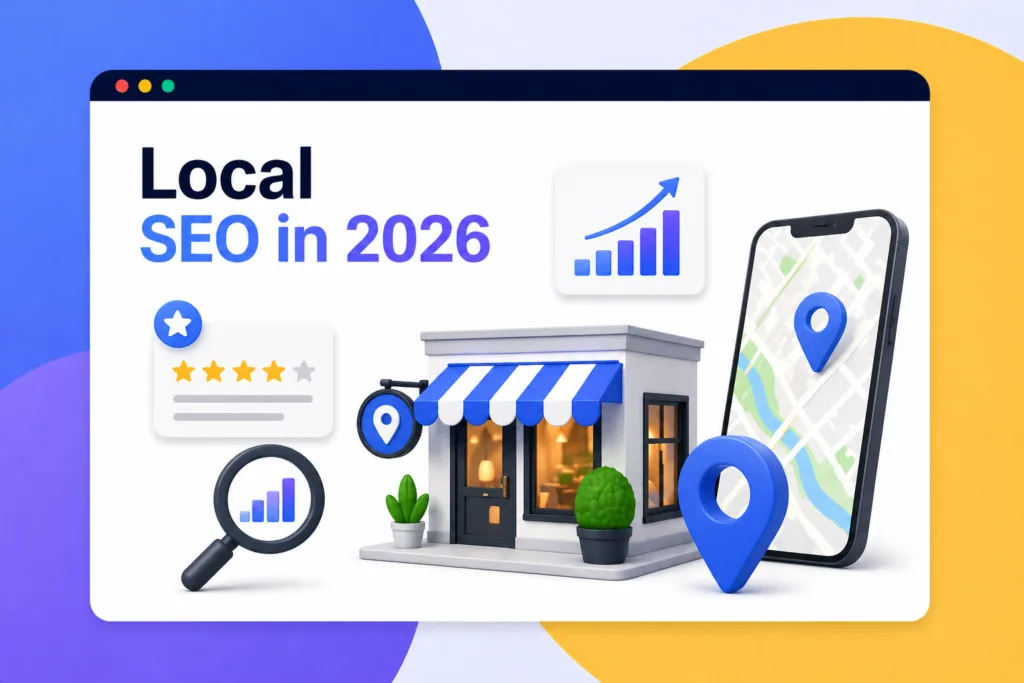
Local SEO in 2026 demands more precision than ever. You compete in a search landscape shaped by AI, hyper‑local signals, and a Google Business Profile that often serves as your digital shop window. If you want to appear in the map pack and capture local intent, you must align your online presence with how search engines now interpret relevance, proximity, and trust.
In 2026, local SEO success depends on optimising your Google Business Profile, earning consistent high‑quality reviews, building strong local signals, and adapting your content for AI‑driven and conversational search. You can no longer rely on basic listings and scattered citations. You need accurate data, location‑focused content, and clear proof that you actively serve your area.
You also need to track what actually drives calls, bookings, and visits. Search results continue to evolve, and businesses that refine their strategy using real performance data stay visible while others fall behind.
Key Takeaways
- Focus on strong local signals, accurate business data, and trusted reviews to improve visibility.
- Adapt your content and profiles to match AI‑driven and conversational search behaviour.
- Measure calls, clicks, and conversions to refine your local strategy over time.
Core Ranking Signals for Local SEO
Google now weighs proximity, relevance, and prominence through measurable signals such as profile completeness, citation accuracy, and review quality. You improve local visibility by tightening control over these core assets and aligning them with real‑world business data.
Google Business Profile Optimisation
Your Google Business Profile (GBP) directly influences Local Pack and Maps rankings. In 2026, Google continues to refine local results through core updates that reward accurate, active, and complete profiles.
Focus on these essentials:
- Primary and secondary categories that precisely match your main services
- A clear, keyword-aligned business description written for users
- Fully populated services and products with pricing where relevant
- Regular posts, offers, and updates
- High-quality, recent photos and videos
Behavioural signals also matter. Profile clicks, direction requests, calls, and booking actions reinforce relevance. Strong mobile usability and fast-loading landing pages support these interactions.
Keep business hours, holiday times, and service areas accurate. Inconsistent or outdated details reduce trust and weaken ranking strength.
Accurate NAP Consistency
NAP stands for Name, Address, and Phone number. Google cross-references this data across directories, map providers, and your website to confirm legitimacy.
Inconsistent formatting, old phone numbers, or duplicate listings dilute authority. Even small differences such as “St.” versus “Street” can create fragmented citations across data aggregators.
Maintain consistency across:
- Your website footer and contact page
- Google Business Profile
- Key UK directories (e.g. Yell, Thomson Local)
- Industry-specific directories
- Social media profiles
Use the same primary phone number everywhere. Avoid call tracking numbers unless implemented correctly with dynamic insertion.
Audit citations at least twice a year. Removing duplicates and correcting outdated listings strengthens local trust signals and improves map visibility.
Importance of Local Reviews
Reviews remain one of the strongest prominence signals in 2026. Google evaluates quantity, recency, diversity, and sentiment rather than raw star ratings alone.
Encourage customers to leave detailed feedback that mentions specific services and locations. Natural keyword usage within reviews reinforces topical relevance.
Prioritise:
- Consistent review generation
- Responses to every review, positive or negative
- Professional, factual replies that reference the service provided
- Resolving complaints publicly when appropriate
Recent reviews carry more weight than older ones. A steady flow of authentic feedback outperforms short bursts of activity.
Google also monitors engagement signals such as owner responses and user interactions. Active review management demonstrates reliability and supports stronger Local Pack positioning.
Evolving Strategies for Local Visibility
Local visibility in 2026 depends on precision and relevance. You win by aligning hyperlocal content with AI-driven personalisation across search, maps, and emerging answer engines.
Hyperlocal Content Creation
You need to move beyond city-level targeting and create content tied to specific neighbourhoods, postcodes, and landmarks. Search engines now evaluate how closely your content matches local intent, not just broad location terms.
Build dedicated landing pages for each service area. Include:
- Neighbourhood names and nearby landmarks
- Local case studies and testimonials
- Area-specific FAQs based on real queries
- Embedded Google Maps with accurate location data
Keep your Google Business Profile aligned with this content. Use consistent NAP details, updated categories, service descriptions, and regular posts that mention local events or seasonal trends.
You should also strengthen local signals through community involvement. Publish short updates about sponsorships, partnerships, or events you support. This reinforces entity relevance and builds trust across organic results, Maps, and AI-generated summaries.
Avoid duplicating the same text across multiple area pages. Write distinct content that reflects actual differences in customer needs within each location.
AI-Powered Personalisation
Search platforms increasingly tailor results based on user behaviour, context, and proximity. You must optimise for dynamic visibility, not fixed rankings.
AI systems assess:
- Review sentiment and recency
- Engagement with your Business Profile
- On-site behaviour signals
- Topical authority within your niche
Encourage detailed reviews that mention specific services and locations. Fresh, descriptive feedback improves your visibility in Map Packs and AI Overviews.
Structure your website content clearly. Use schema markup for services, locations, FAQs, and reviews so AI systems can extract accurate information. Clear headings, concise answers, and well-defined service pages increase your chances of appearing in conversational and voice-driven searches.
You should also personalise on-site experiences. Serve location-aware content, highlight nearby branches, and adjust calls to action based on user location. These refinements improve engagement metrics, which directly influence how algorithms evaluate your local relevance.
Leveraging New Technologies and Platforms
Local visibility in 2026 depends on how well you connect your presence across social platforms, mapping ecosystems, and mobile experiences. You need consistent data, platform‑specific optimisation, and fast, user‑centred design to remain competitive.
Integration with Local Social Media
Local social signals now influence discovery beyond traditional search results. Users find businesses through Instagram location tags, TikTok recommendations, Facebook community groups, and LinkedIn local service posts.
You should align your business name, address, phone number, and service categories across all profiles. Inconsistent details weaken trust signals and confuse both users and algorithms.
Focus on:
- Geo‑tagged posts and stories tied to specific locations
- Community engagement in local groups and forums
- Short‑form video that demonstrates services in real settings
- User‑generated content such as reviews, tagged photos, and testimonials
Encourage customers to tag your location and leave platform‑native reviews. These actions reinforce local relevance and create searchable content linked to your area.
AI‑driven feeds increasingly personalise local recommendations. You improve visibility when you publish consistent, location‑specific content that reflects real expertise and experience.
Emerging Mapping and Navigation Tools
Google Maps remains central, but local discovery now spans multiple navigation tools, in‑car systems, and voice assistants. Apple Maps, Waze, and vehicle dashboards influence route‑based searches.
You must fully optimise your Google Business Profile and equivalent listings on other mapping platforms. Accurate categories, service descriptions, opening hours, and attributes directly affect visibility.
Prioritise:
- Primary and secondary categories aligned with core services
- Service areas defined precisely rather than broadly
- High‑quality photos of premises, staff, and completed work
- Regular updates and posts within your profile
Voice search plays a larger role in navigation queries. People ask for “nearest emergency plumber” or “best rated café near me”, so your listing must include clear services, strong review signals, and consistent location data.
Incorrect pins, outdated hours, or duplicate listings reduce trust and ranking strength. Audit your listings quarterly to maintain accuracy.
Mobile‑First User Experience
Most local searches occur on mobile devices. If your site loads slowly or displays poorly, users leave before contacting you.
You should design for speed and clarity first. Aim for fast loading times, responsive layouts, and tap‑friendly buttons.
Key requirements include:
- Core Web Vitals compliance
- Click‑to‑call and click‑for‑directions buttons placed prominently
- Short contact forms with minimal required fields
- Clear service pages focused on one location or area
Structure pages around specific services and towns rather than broad, generic content. This improves relevance for hyper‑local searches.
Ensure that structured data markup reflects your business details, reviews, and services. Search engines and AI‑driven results rely on this data to interpret and display your information accurately.
Measuring Success and Future Trends
You need clear metrics and a forward-looking plan to compete in AI-influenced local search. Focus on measurable local actions, monitor shifts in Google’s local features, and build assets that remain valuable despite algorithm changes.
Key Performance Indicators for Local Campaigns
Track performance where it directly affects revenue, not just rankings.
Start with Google Business Profile (GBP) insights. Monitor calls, direction requests, website clicks, and message enquiries. These actions show real local intent and often convert faster than standard organic traffic.
Measure Map Pack visibility for priority keywords such as “emergency plumber near me” or “family dentist in Leeds”. Use geo-specific rank tracking across different postcodes, not just a single town centre location.
Review signals matter more in 2026, especially as AI-generated summaries pull from ratings and review content. Track:
- Average star rating
- Review frequency
- Review keyword themes
- Owner response rate and time
Also monitor conversion metrics on local landing pages: click-to-call taps, form submissions, booking completions, and assisted conversions from local queries.
Finally, measure impressions and engagement in AI-driven results where available. If your content appears in local AI summaries, track associated traffic changes and branded search growth.
Preparing for Algorithm Updates
Local search has shifted rapidly with AI Overviews, zero-click results, and deeper integration between Maps and organic listings. You should assume further integration rather than separation.
Maintain strict NAP consistency across your website, GBP, and third-party directories. Inconsistent business data still triggers ranking instability after updates.
Audit your GBP quarterly. Check primary and secondary categories, service areas, opening hours, and attributes. Google increasingly relies on structured profile data to generate local summaries.
Strengthen entity signals. Align your website schema markup, internal linking, and location pages with your GBP details. Use LocalBusiness schema and ensure each location has unique, specific content.
When updates roll out, compare:
- Map Pack position changes
- GBP action trends
- Organic traffic by location page
- Review velocity
React to patterns, not single-day fluctuations.
Sustainable Strategies for 2027 and Beyond
Build assets that remain valuable even if ranking mechanics change.
Invest in location-specific content that answers real service questions. Publish pages that explain pricing factors, service areas, and common local issues. AI systems often extract answers from clear, structured content.
Strengthen your reputation pipeline. Encourage consistent, genuine reviews from verified customers. Respond professionally and reference specific services in your replies to reinforce relevance signals.
Optimise for mobile and voice-driven searches. Use natural phrasing that reflects how people speak, such as “Who fixes boilers near me?” Ensure fast load times and clear click-to-call functionality.
Diversify visibility. Maintain accurate listings on major directories and industry platforms, and build local backlinks from chambers of commerce, local news sites, and community organisations.
Prioritise trust, accuracy, and usefulness. Those signals continue to shape local visibility across Maps, AI summaries, and organic results.
Get In Touch
If you want to strengthen your local visibility in 2026, take the next step now. You can improve rankings, calls, and in‑store visits with a focused local SEO plan built around your business goals created by an experienced local SEO consultant in Bedford.
Get in touch for a free review of your local performance.