 Nigel Adams
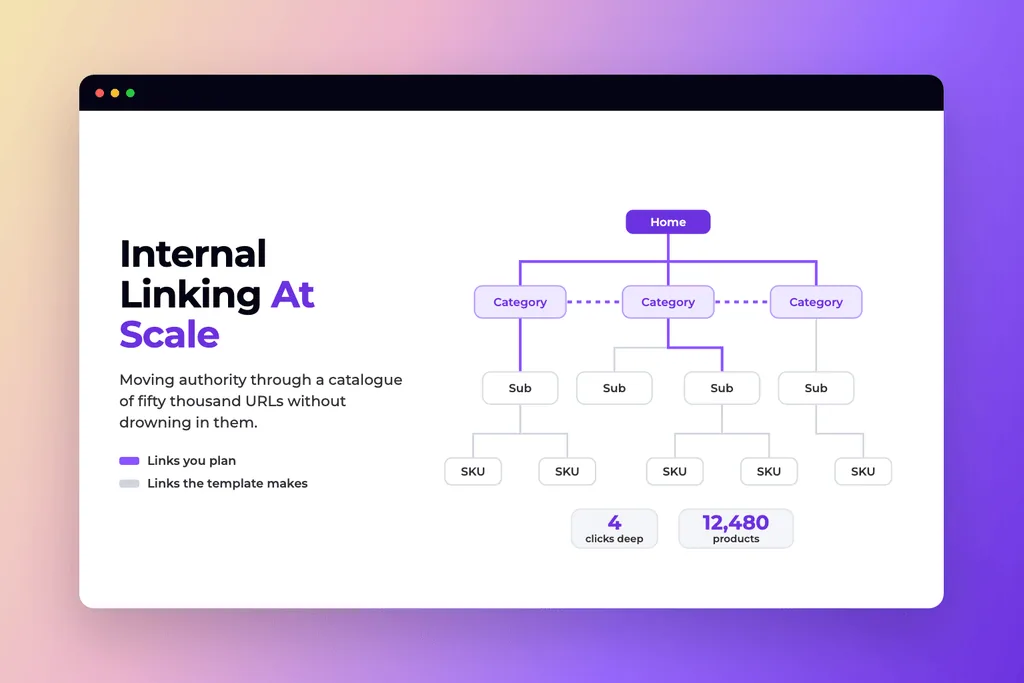
A fifty thousand URL catalogue has a problem a hundred page site does not. Every product you add makes the average product slightly harder to reach, and nobody notices until organic revenue flattens and the deep pages are not in the index.
Internal linking on a large ecommerce site is the job of moving authority and crawl attention from the pages that have it to the pages that sell, at a scale where you cannot place links by hand. It is systems work rather than editorial work.
This is what I look at, roughly in the order the problems bite.
Key Takeaways
- At scale, internal linking is a system you design once, not links you place individually.
- Category and subcategory pages are the engine. Products inherit what the categories pass down.
- Faceted navigation is where most large sites leak crawl budget, and the fix is deciding which combinations deserve a crawlable link.
- Click depth from the homepage is the single most useful number to watch.
Why Internal Linking Breaks At Scale
Small sites get away with a lot because everything is two clicks from everything else. Large catalogues break in specific ways.
Products end up five or six clicks deep, which is usually a pagination problem. Authority pools in the homepage and a handful of top categories and never reaches the long tail. Faceted navigation generates near-infinite combinations that absorb crawling and return almost nothing. Out of stock and discontinued products quietly become dead ends. And "related products" modules, which look like internal linking, often render in JavaScript after load and are not links at all as far as a crawler is concerned.
Worth checking that last one before anything else. I have seen sites where the entire related-products strategy was invisible to search engines.
Build Category Hubs That Actually Carry Links
Category pages are where the authority arrives and where it gets distributed. On most large stores they are treated as a grid of products and nothing else, which wastes them.
A category page should link clearly to its subcategories, to a sensible number of products, and sideways to genuinely related categories. Sideways links are the ones most often missing, and they are how a shopper on walking boots finds waterproof socks.
Pagination deserves attention because it decides depth. An endless chain of next links buries page forty. Exposing a range of page numbers, so a crawler can jump, keeps depth manageable. If you have infinite scroll, make sure there is a paginated set of real links behind it.
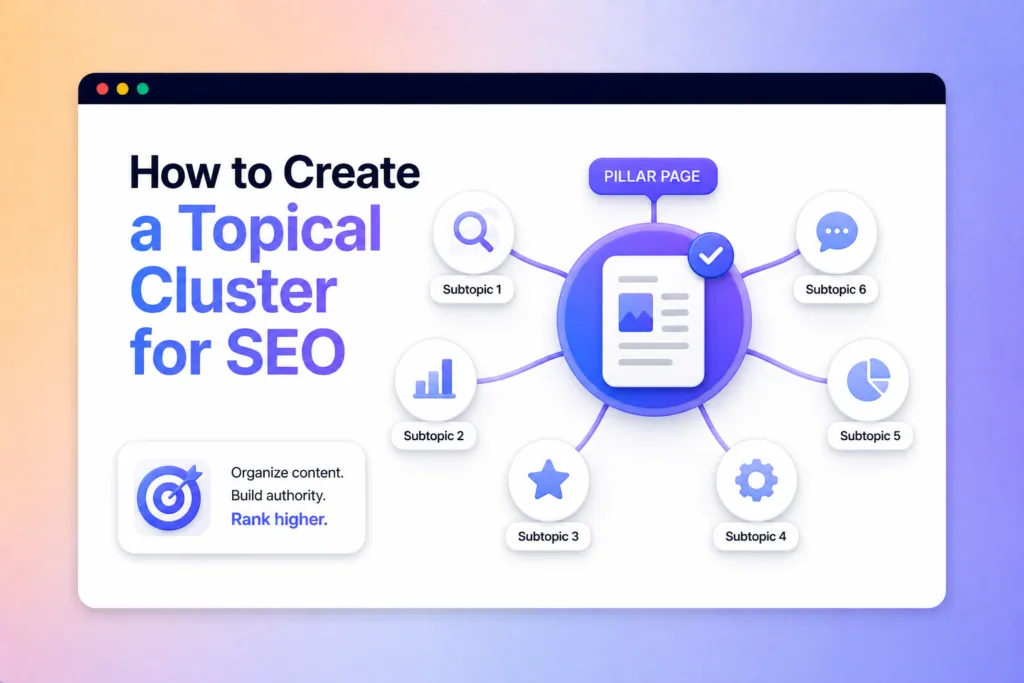
Where you have editorial content, buying guides and comparisons, link it into the relevant categories and link back out to them. That is the same topical cluster idea applied to a catalogue, and it is the cheapest way to give a thin category page something to say.
Decide Which Faceted URLs Deserve A Link
Faceted navigation is the biggest single lever on a large store, and the most commonly mishandled.
The decision is per combination, not global. Some facets have real demand behind them: brand plus category, colour plus category, size plus category in clothing. Those deserve an indexable URL with a crawlable link, their own title and some unique copy. Most combinations have no demand at all, and three facets stacked together almost never do.
For the combinations you want, link to them properly from the category page. For the ones you do not, the usual approach is to keep the links crawlable but the pages noindexed, or to stop the links being crawlable at all. What you should not do is leave every combination generating a linked, indexable URL and hope the canonical sorts it out. It will not, and you will spend your crawl budget discovering filter permutations.
Keyword research tells you which facets have demand. This is the point where ecommerce SEO stops being technical and starts being commercial, because the same research tells you where the ecommerce PPC budget should go.
Link Products To Each Other With Intent
Related product modules are usually driven by whatever the platform suggests, which tends to be whatever sold recently. That is fine for revenue and poor for linking.
Better is a mix with a purpose. Link complementary products, the things bought together. Link alternatives at different price points, which helps shoppers who have landed on the wrong item. Link up to the parent category every time, with descriptive anchor text, since that single link is what keeps deep products from being orphaned.
Handle out of stock products deliberately. If the item is coming back, keep the page and link to alternatives. If it is gone for good, redirect to the closest equivalent or the parent category. Leaving a dead product page with no outbound links wastes whatever authority it accumulated.
Get Anchor Text Right Without Writing Fifty Thousand Of Them
You cannot hand-write anchors at this scale, and you should not want identical anchors everywhere either.
Templates are the answer, with enough variables to produce variety. Product name plus category, brand plus product type, category name plus a qualifier. The thing to avoid is every link on the site reading "view product" or "click here", which is common and tells search engines nothing about the destination.
Breadcrumbs do a lot of quiet work here. They are consistent, descriptive, they establish hierarchy, and they are cheap to implement properly. Mark them up with BreadcrumbList schema while you are there.
Spend Crawl Budget On Pages That Earn
Crawl budget only matters once a site is large, and then it matters a lot.
Look at your server logs rather than guessing. You are looking for what proportion of crawling goes to filter URLs, internal search results, out of stock products and paginated pages beyond the first few, against what goes to categories and live products. On sites that have never looked, the split is often worse than anyone expects.
The fixes follow from the diagnosis: stop linking to what you do not want crawled, keep XML sitemaps to canonical indexable URLs only, and make sure your highest-margin categories are reachable in two or three clicks. Technical SEO work, but with a commercial filter on which pages are worth the attention.
How To Find What Is Broken Now
Crawl the site and look at four numbers.
Click depth from the homepage, which tells you whether products are reachable. Internal links per URL, where pages with one inbound link are usually accidents. Orphaned pages that appear in your sitemap or analytics but are not linked from anywhere. And the ratio of filter URLs to real pages, which tells you whether faceted navigation is under control.
Cross-reference that against which pages actually make money. A product with four inbound links and good margin is a quicker win than a category with forty links and no demand. Then fix by template rather than by page, because the same change applied across a category type will usually move hundreds of URLs at once.
If you want this done properly on your catalogue, it is part of how I run ecommerce SEO, and it is usually the first thing I look at in an SEO audit. Get in touch and tell me how big the catalogue is.
Frequently Asked Questions
How should large ecommerce sites structure internal links?
Around category and subcategory hubs. Category pages should link to their subcategories, a sensible number of products, and sideways to related categories, with pagination that exposes page numbers rather than an endless chain of next links. Products should always link up to their parent category with descriptive anchor text.
How do you handle faceted navigation for SEO?
Decide per combination rather than globally. Facets with real search demand, typically brand plus category or colour plus category, deserve an indexable URL with a crawlable link and unique copy. Combinations with no demand should either be noindexed or not linked crawlably at all. Leaving every combination linked and indexable wastes crawl budget on filter permutations.
What is click depth and why does it matter?
Click depth is the number of clicks from the homepage to reach a page. On large catalogues products often end up five or six clicks deep because of pagination, which makes them harder to crawl and slower to index. Keeping high-margin categories within two or three clicks is the practical target.
How do you write anchor text at scale?
With templates that include enough variables to produce variety, such as product name plus category or brand plus product type. The thing to avoid is every link reading "view product" or "click here", which tells search engines nothing about the destination. Breadcrumbs do a lot of this work consistently and cheaply.