
You improve SEO when you organise your content around clear themes instead of publishing isolated articles. Search engines reward structure, depth and relevance, and that is exactly what topic clusters deliver.
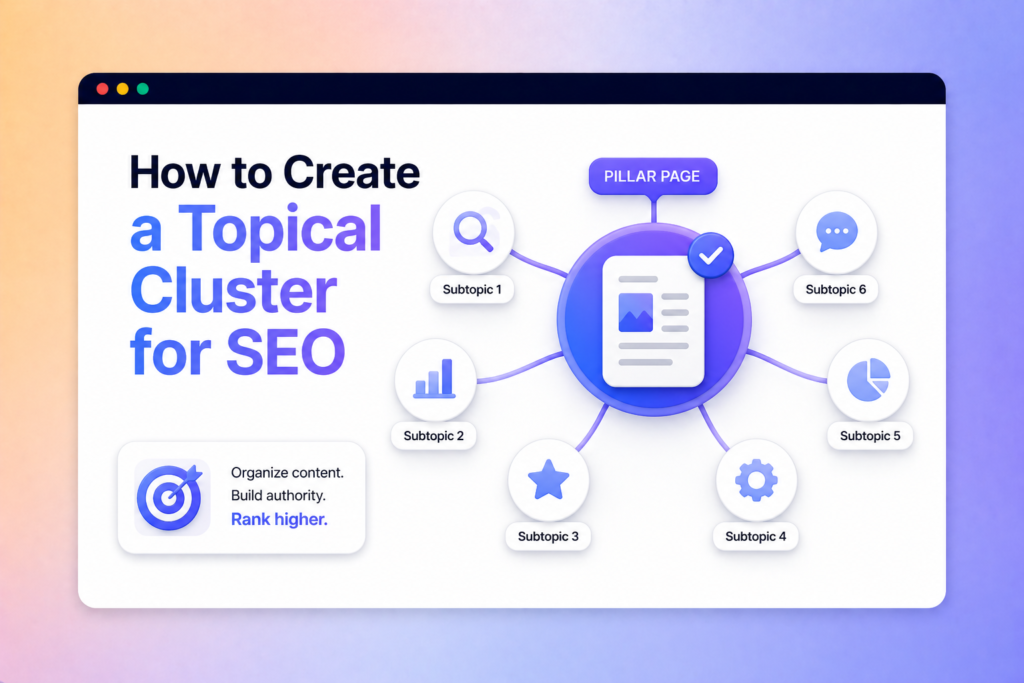
To create a topical cluster for SEO, you choose a core topic, build a comprehensive pillar page around it, publish supporting articles that cover related subtopics in depth, and connect them with strategic internal links. This structure strengthens your content strategy, signals topical authority and makes it easier for search engines to understand your expertise.
When you plan clusters with intent, align them to business goals and track performance, you turn scattered content into a focused system that supports rankings, visibility and long-term growth.
Key Takeaways
- Build clusters around a central theme supported by in-depth related content.
- Use clear internal linking to show structure and reinforce topical relevance.
- Monitor rankings, traffic and engagement to refine your cluster over time.
Core Principles of Topical Clusters
A topical cluster organises related content into a clear structure that search engines can interpret and users can navigate. You build focused coverage around one central theme, support it with connected pages, and strengthen it through deliberate internal linking.
What Constitutes a Topical Cluster
A topic cluster is a structured group of interrelated pages built around one clearly defined subject. It includes one comprehensive pillar page and several focused cluster pages that explore distinct subtopics in depth.
You choose a core theme broad enough to support multiple articles, but narrow enough to maintain topical relevance. For example, “email marketing strategy” can support subtopics such as automation workflows, segmentation, compliance, and performance metrics.
A strong content cluster shares three traits:
- Clear topical boundaries
- Distinct subtopics with minimal overlap
- Logical hierarchy within your site structure
You avoid publishing disconnected articles that compete with each other. Instead, you create organised topical coverage that signals depth and coherence to search engines.
Role of Pillar and Cluster Pages
Your pillar page acts as the central hub of the cluster. It delivers a broad, structured overview of the main topic and links to detailed supporting pages.
Think of pillar content as the entry point. It targets a broad, high-level keyword and introduces the main subthemes without exhausting them.
Your cluster pages focus on specific aspects of that topic. Each one targets a more precise search query and expands on a single area mentioned on the pillar page.
For clarity:
| Page Type | Purpose | Keyword Focus | Depth |
|---|---|---|---|
| Pillar Page | Broad overview | Broad, high-volume term | Comprehensive but not granular |
| Cluster Pages | Detailed exploration | Specific, intent-driven terms | Narrow and in-depth |
This structure prevents keyword cannibalisation and strengthens topical relevance across the content cluster.
Significance of Internal Linking
Internal linking connects your pillar page and cluster pages into one cohesive system. Without internal links, your topic cluster becomes a collection of isolated articles.
You should link:
- From the pillar page to each relevant cluster page
- From each cluster page back to the pillar page
- Between related cluster pages where appropriate
Use descriptive anchor text that reflects the target topic. This helps search engines understand semantic relationships and hierarchy.
Strategic internal linking improves crawlability and clarifies your site structure. It also guides users through related content, increasing engagement and helping them move logically through your content hub.
Avoid excessive or irrelevant links. Each internal link should reinforce topical alignment and support navigation.
Building Topical Authority
Topical authority develops when you demonstrate consistent, in-depth coverage of a defined subject area. You achieve this by expanding your content clusters thoughtfully rather than publishing scattered articles.
Search engines evaluate how thoroughly you address a topic. If you cover core subtopics, answer related questions, and maintain clear internal linking, you strengthen your perceived expertise.
You build topical authority when you:
- Cover primary and secondary queries within a niche
- Maintain consistent terminology and structure
- Update pillar content as the cluster expands
- Eliminate thin or redundant pages
Over time, this structured topical coverage increases your visibility for related keywords. A well-built content cluster signals that your site functions as a reliable content hub within its subject area.
Planning a Topical Cluster Strategy
You build a strong topical cluster by selecting a focused pillar topic, validating it with data, and structuring supporting subtopics around clear search intent. You also protect performance by managing keyword cannibalisation and preventing content decay through regular audits and tracking.
Choosing a Core Topic and Pillar
Start with a seed keyword that reflects a core service, product, or expertise area. This term becomes your potential primary keyword for the pillar page.
Check monthly search volume, keyword difficulty (KD), and the current SERP landscape using SEO tools such as Semrush, Surfer, or similar platforms. If the KD is too high for your domain strength, narrow the topic to a more specific variation.
Your pillar must target a broad theme with clear informational intent or commercial investigation intent. It should answer foundational questions and link naturally to supporting cluster content.
Test viability with three criteria:
- Sustainable search demand
- Clear alignment with your business goals
- Enough depth to support multiple supporting subtopics
Avoid vague themes. “Digital marketing” is often too broad, while “local SEO for estate agents” creates a manageable and strategic starting point for your content strategy.
Conducting Keyword Research and Analysis
Effective keyword research shapes your entire keyword strategy. Begin by expanding your seed keyword using keyword suggestions from tools such as the Keyword Magic Tool or similar databases.
Group related terms through keyword clustering. Many SEO tools now generate automatic keyword clusters based on SERP overlap, which helps you see how Google groups topics.
Evaluate each cluster using:
- Monthly search volume
- Keyword difficulty (KD)
- Dominant search intent
- Competing domains in the SERP
Run a keyword gap analysis against direct competitors to identify missing opportunities. Focus first on terms where you rank between positions 5–20, as these offer realistic gains.
Prioritise keywords with clear user intent. A strong topical cluster balances informational queries with mid‑funnel and transactional phrases where relevant.
Mapping Supporting Subtopics and Content Ideas
Turn your keyword clusters into a structured topical map. The pillar sits at the centre, while each keyword cluster becomes a defined piece of cluster content.
Each supporting page should target one clear primary keyword and closely related variations. Avoid mixing multiple intents on one page.
You can organise your plan in a simple table:
| Page Type | Primary Keyword | Intent | Internal Links |
|---|---|---|---|
| Pillar | Broad core topic | Informational | Links to all clusters |
| Supporting page | Specific subtopic | Informational / Commercial | Links back to pillar |
Generate content ideas by analysing top-ranking pages. Identify gaps in depth, examples, data, or structure, then improve on them with clearer explanations and updated references.
Ensure every supporting subtopic answers a distinct question. This clarity strengthens relevance and improves your GEO and SEO visibility.
Avoiding Keyword Cannibalisation and Content Decay
Keyword cannibalisation occurs when multiple pages compete for the same primary keyword and intent. This weakens rankings and confuses search engines.
Prevent this by assigning one primary keyword per page during planning. Use position tracking tools to monitor overlapping URLs in the SERP.
Conduct a regular content audit to detect:
- Pages targeting identical keywords
- Thin or outdated articles
- Declining impressions or clicks
Address issues decisively:
- Consolidate overlapping pages
- Redirect redundant URLs
- Update declining articles to combat content decay
Refresh statistics, refine internal links, and align pages with current search intent. Maintaining structure and relevance ensures your topical cluster remains authoritative and competitive over time.
Content Creation and Interlinking Best Practices
You build topical authority by creating focused content and connecting it through a deliberate internal linking structure. Strong pillar pages, precise cluster content, and clear site hierarchy work together to improve rankings, readability, and user experience.
Crafting Pillar and Cluster Pages for Depth
You start with a pillar page that acts as the core content hub for your topic. It targets a broad, high-intent keyword and covers the subject comprehensively, without going into excessive detail on every subtopic.
Structure your pillar page with:
- Clear H2 and H3 headings
- Concise definitions and explanations
- Links to supporting pages for deeper guidance
- Relevant visuals, such as diagrams or short videos
Each section should introduce a subtopic and direct readers to dedicated cluster content. This approach strengthens your content hierarchy and prevents keyword cannibalisation.
Your supporting pages must focus on one narrow intent. Go deeper than the pillar, answer specific questions, and address practical use cases. Optimise each page for on-page SEO, including title tags, meta descriptions, internal links, and structured headings.
Avoid repeating the pillar word for word. Instead, expand on it. This separation of scope improves topical relevance and supports both page authority and site authority over time.
Designing an Effective Internal Linking Structure
You need a clear and consistent internal linking structure. Without it, your cluster content becomes isolated and loses ranking potential.
Follow a simple model:
- Pillar page → links to all relevant cluster pages
- Cluster pages → link back to the pillar
- Cluster pages → cross-link where contextually relevant
This creates a visible content hierarchy that search engines can crawl and understand. It also distributes link equity across related URLs.
Place links naturally within body copy, not just in navigation or footers. Contextual internal linking carries more weight and improves user experience.
Keep your site structure shallow. Important pages should sit within a few clicks of your homepage. A flat, organised site structure supports crawling efficiency and reinforces your content hub as an authoritative resource.
Optimising Anchor Text and Link Equity Flow
You control how search engines interpret linked pages through anchor text. Use descriptive anchor text that reflects the target page’s primary topic.
For example:
- Use: “technical SEO audit checklist”
- Avoid: “click here”
Descriptive anchor text strengthens topical signals and improves accessibility. It also helps users understand what they will find after clicking.
Vary your phrasing naturally. Over-optimised, repetitive anchor text can appear manipulative and reduce clarity.
Think strategically about link equity flow. Pages with strong backlinks or high traffic should link to priority cluster pages. This transfers authority internally and supports rankings for competitive terms.
Audit your internal links regularly. Remove broken links, update outdated references, and ensure new content integrates into your existing structure.
Enhancing User Experience Through Site Hierarchy
Your content cluster must support UX as much as SEO. A logical site hierarchy helps users find relevant information quickly and reduces bounce rates.
Organise content so that:
- The pillar page acts as the main hub
- Categories reflect core topics
- Supporting pages sit clearly beneath their parent topic
Use breadcrumbs and clear navigation menus to reinforce structure. This improves readability and orientation, especially on large sites.
Break up long pages with short paragraphs, bullet points, and embedded media such as videos. These elements improve engagement and make complex information easier to absorb.
When you align internal linking, site structure, and content creation with user intent, you create a system that supports rankings while remaining practical and usable.
Measuring and Refining Cluster Performance
You build topical clusters to improve rankings, search visibility, and lead generation, so you must measure them as a connected system rather than as isolated pages. Focus on organic rankings, traffic quality, and how well each piece supports authority, E‑E‑A‑T, and conversions.
Tracking Rankings and Search Visibility
Track organic rankings at both page and cluster level. Monitor your pillar page’s primary terms and the long‑tail queries targeted by supporting articles.
Use a position tracking tool within your preferred SEO tools to group keywords by cluster. This lets you see:
- Average ranking position across the cluster
- Keyword distribution (top 3, top 10, top 20)
- Cannibalisation between related pages
In Google Search Console (GSC), filter by URL prefix to analyse search visibility for the entire cluster. Review impressions alongside average position to identify pages that rank on page two and need optimisation.
Pay attention to query intent. If a supporting article ranks for commercial terms, refine internal links and on‑page signals to strengthen relevance and E‑E‑A‑T.
Analysing Organic Traffic, Impressions, and Clicks
Rankings matter, but organic traffic, impressions, and clicks show how users respond. In GSC, compare clicks and impressions for each URL in the cluster over a fixed period, such as 90 days.
Look for:
- High impressions, low clicks → improve title tags and meta descriptions
- Growing clicks, stable rankings → stronger SERP appeal
- Traffic spikes tied to specific subtopics → expand related content
In your analytics platform, evaluate content performance beyond sessions. Review engagement time, scroll depth, and assisted conversions tied to lead gen forms.
Connect cluster URLs to your CRM to measure downstream impact. If a supporting article drives demo requests or newsletter sign‑ups, treat it as a strategic asset, not just an informational post.
Continual Improvement with Content Briefs and Audits
Clusters require structured refinement. Run a focused content audit every 6–12 months to assess freshness, internal linking, and search intent alignment.
Audit for:
- Outdated statistics or weak evidence affecting E‑E‑A‑T
- Thin sections that fail to answer related queries
- Overlapping articles competing for the same keyword
Update or merge pages where necessary. When you identify gaps, create a detailed content brief that defines primary and secondary keywords, internal links to pillar and cluster pages, schema requirements, and generative engine optimisation considerations.
Treat each brief as a performance document. Align it with ranking targets, search visibility goals, and measurable SEO performance outcomes rather than publishing content without a defined objective.
Conclusion
You build a topical cluster by organising your content around a clear pillar and supporting it with focused subtopics. You connect everything through deliberate internal linking and align each page with distinct search intent.
When you apply this structure consistently, you avoid keyword cannibalisation and strengthen your site architecture. Search engines can understand your expertise more easily, and users can navigate your content without friction.
Keep your approach practical and repeatable:
- Choose a commercially relevant pillar topic
- Audit and optimise existing content before creating new pages
- Map keywords to intent and the buyer journey
- Link pillar and cluster pages in a clear hierarchy
- Monitor rankings, traffic and engagement regularly
Use data to guide your decisions. Review performance in Search Console and your SEO tools, and refine pages that underperform or overlap.
A strong topical cluster does not rely on volume alone. You focus on relevance, structure, and clarity, then expand methodically as your authority grows.